
Crab Aquarium Draw Puzzle
What players say
Crab Aquarium Draw Puzzle works because its central mechanic is easy to understand but flexible enough to support varied level design. The absence of timers and penalties makes it a good fit for players who want a low-stress brain teaser, and the multiple-solution approach rewards curiosity rather than memorization. Its family-friendly presentation and simple controls lower the barrier for younger players, though anyone seeking fast-paced action or complex systems will find it deliberately minimal.
About
Drawing the Water Path
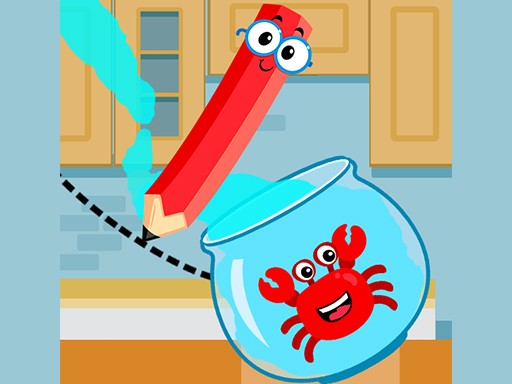
The core task in Crab Aquarium Draw Puzzle is simple to state and surprisingly open-ended in practice. Players draw a single continuous line from a water source to an empty aquarium. If the line breaks, water cannot flow, so the shape of the path matters as much as where it starts and ends. Because the line must stay unbroken, sharp turns and awkward angles can cause problems, and the game gently signals when a route will not work. The goal is not just to connect two points but to fill the tank and make the crab inside happy.
Level Obstacles and Multiple Solutions
Each level presents a different arrangement of obstacles and paths. Some layouts may require you to route around barriers, while others may allow a more direct approach. Many levels accept more than one solution, which changes how you play: instead of hunting for a single correct answer, you can try a shape, watch the result, and adjust. That trial-and-error loop is where the logic and creativity overlap. The game does not pressure you with timers or penalties, so a failed attempt costs nothing except the time spent redrawing.
Controls and Feedback
On a touchscreen, you draw with a finger; on a computer, you use a mouse. The controls are intentionally minimal, which keeps the focus on the puzzle itself. Feedback is gentle rather than punishing, helping you understand why a line did not work without interrupting the relaxed tone. This makes the game approachable for children and adults alike, and the bright, cheerful art style supports that family-friendly feel.
Approaching Each Puzzle
Before drawing, it helps to study the layout of obstacles. Because many levels have multiple solutions, forcing the same idea repeatedly is less effective than trying a completely different route. Keeping the line continuous and avoiding sharp turns that might break the flow are practical habits. Over time, regular play can improve your ability to visualize efficient paths before you draw them, turning the game into a light mental workout rather than a test of reflexes.
Compatibility
FAQ
Comments
Sign in to comment
You must be logged in before posting a review or rating.
No comments yet. Be the first to comment!



Editorial Notes